Publications
Highlights from the Health and Ageing in Difference Conference 2026
23 July 2026
By Av De Vries, Consumer Representatives Coordinator
I was pleased to attend the Health and Ageing in Difference Conference held from 10 to 12 June 2026 at the National Convention Centre. These two conferences were held consecutively, bringing together leaders, researchers, policymakers, and advocates to advance the health and wellbeing of LGBTIQ+ people at every stage of life. Across the two days, I heard from speakers sharing research, lived experience, and practical insights on inclusion, ageing, health, family violence, data collection, and community leadership.
You can find the full program on the conference website.
Day 1
Conversations with William Trewlynn
Co-founder and Managing Director of YarnnUp
For the opening plenary of the conference, William Trewlynn, a proud Nucoorilma, Anaiwan, and Dunghutti man, spoke about reconciliation and asked, “How do you let good intent drive change?”. His agency, YarnnUp, works in First Nations Engagement, Strategy and Design, and he is no stranger to people wanting to tick boxes.
Key points included:
- “How do you build capabilities to listen?”
- “[People are] fearful to get it wrong.”
William stated, “If you can’t articulate the ‘why’, then you’ve already lost”, in reference to reconciliation projects. He spoke about how people and organisations often approach YarnnUp unable to explain why they want to undertake a project beyond simply ticking a box.
He also spoke about how people are often “fearful to get it wrong” when it comes to approaching and collaborating with Indigenous Australians. “Don’t let Aboriginality be a barrier to building effective relationships”, he said, as difference is so often viewed as a barrier.
I often use the phrase ‘presence over perfection’. Often, we worry so much about getting it wrong that we don’t start at all. Working within consumer representation, people can be unsure about how to be consumer representatives or how to interact with consumers. This is your reminder not to let a lack of perfection become a barrier, especially when working with marginalised communities like Aboriginal and Torres Strait Islander peoples.
Plenary Panel: From Insight to Impact: New LGBTIQA+ Approaches to Ending Violence
With Family Access Network, InterAction, ACON and Living Proud
Family violence is already a complex area. Add marginalisation, limited data and erasure, and it makes everything even more complicated. This panel discussed the complex area of domestic and family violence.
Sam Rodgers from ACON discussed how patriarchy is a key driver of violence.
Cody Fisher from Family Access Network works with young LGBTIQA+ people who have experienced family violence, using art therapy as a tool for healing. He discussed how art therapy gives the client autonomy on how much they engage, provides space to unpack experiences, and often allows clients to engage in non-verbal ways.
Key themes included:
- Limited data in this space makes it hard to access funding and identify what’s needed.
- Lack of recognition of domestic and family violence experienced and perpetrated by LGBTIQA+ people.
- LGBTIQA+ people aren’t represented in mainstream family and domestic violence campaigns.
- Rainbow Health Australia | LGBTIQ Family Violence Prevention Project was highlighted as an important resource.
When faith and care intersect: improving LGBTIQA+ inclusion in faith-linked health services
Joel Anderson, Australian Research Centre in Sex, Health and Society
Conversion practices still happen within our healthcare system, including in faith-linked health services. Many people accessing these services cannot choose or change service providers.
Often, there is an assumption that LGBTIQA+ people cannot be religious or spiritual. This is wrong and perpetuates harm to religious and spiritual LGBTIQA+ people.
Joel discussed how faith linked settings can either amplify or reduce harm. Ultimately, it’s how the service conducts itself that matters.
Resources highlighted included:
- Improving spiritual healthcare for LGBTQA+ Australians: Beyond conversion practices – A community Report
- A Guide to Improving Safety in Pastoral Care with LGBTQA People
Elevating LGBTIQA+ Voices in Men’s Health and Masculinities Policy
David Casey, Director, Inclusive Health Policy, Population Health Division, Australian Government, Department of Health, Disability and Ageing
A key takeaway from this session was:
“LGBTIQA+ communities have always challenged that there are many ways to be a man.”
Celebrating Our Diversity
Mitch Brown, former AFL footballer and advocate for positive masculinity
The keynote speaker of the day was Mitch Brown, who publicly came out as bisexual in August 2025. Mitch is the currently the only current or former Australian Football League (AFL) player to have publicly come out.
He centred his keynote around the toll of presenting as a straight man and hiding a key part of himself while playing professionally in the AFL. Growing up in an environment that prized straightness and participating in the AFL culture that often presented only one way to be a man, Mitch felt that he couldn’t look up to Queer people because of the shame he associated with his identity, leading him to “double down [on his] straightness”. As he continued his career, he started to believe the lie he had sold to himself [of being a straight man].
The incident that eventually led him to retire from AFL happened when a teammate, who a week before had posed for photos holding signs that promoted inclusivity for IDAHOBIT Day, stated that he’d “rather be in a cage full of lions than have a shower next to a gay man”. The undertone reflected a harmful stereotype that gay men are predators. The player wasn’t aware that he was sitting next to a bisexual man.
I have recently started playing team sports and have been warmly welcomed into my club. As I learn the game and experience the team spirit, it has reminded me how important sport can be. After having negative experiences in high school and seeing the homophobia from many male professional athletes, team sports didn’t feel like a place where I could safely be involved in as an openly queer man. I have since fallen in love with my sport and having the exercise and socialisation every week has done wonders for my mental and physical health. I don’t follow or know much about AFL, but from my viewpoint, Mitch’s coming out reaches far beyond the professional male Australian Football League. Sports is for everyone – even if you don’t have anyone who is openly LGBTIQA+ on your team, that doesn’t mean they aren’t on your team or a part of your club. This means every team (sports or otherwise) needs an inclusive culture so that everyone feels safe to show up and play.
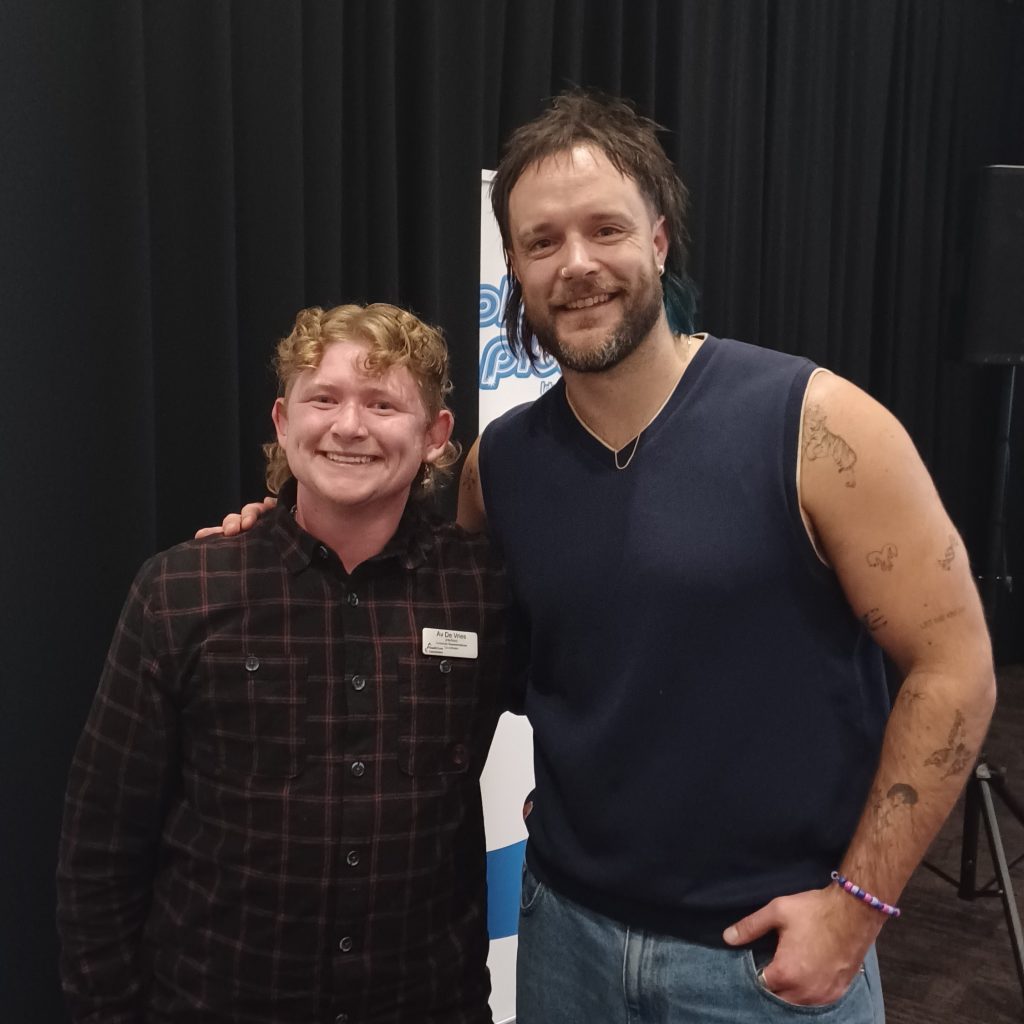
Caption: Av with Mitch Brown (former AFL player)
Day 2
Welcome to Ageing in Difference, launch of Silver Rainbow and Silver Pride Navigator websites
Nicky Bath, CEO of LGBTIQ+ Australia
Nicky discussed the divide that exists within the LGBTIQ+ community, especially when it comes to the rights and safety of Trans and Gender Diverse people.
Resources highlighted included:
- Silver Rainbow: Ageing and Aged Care – LGBTIQ+ Health Australia
- Ageing Fabulously: A podcast for the aged care sector – LGBTIQ+ Health Australia
A particularly memorable moment for me was when Uncle Paul Calcott, a Wiradjuri artist, presented LGBTIQ+ Health Australia with an artwork inspired from his experience being involved in the project.
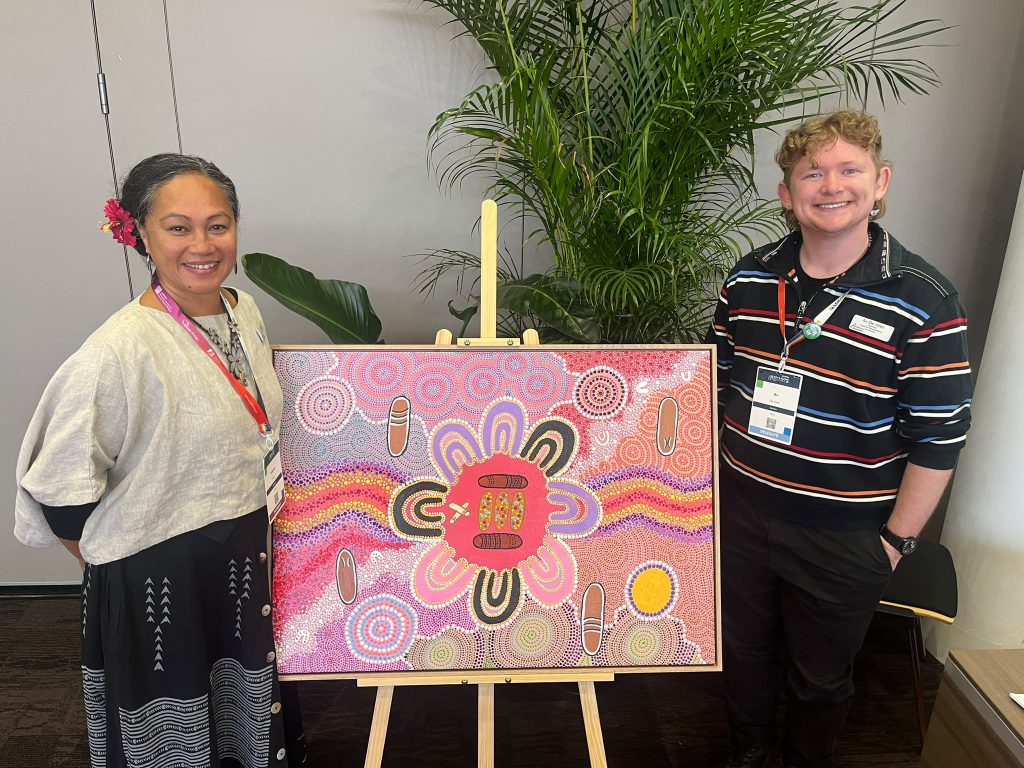
Caption: Ivapene and Av at Health in Difference Conference with artwork from Uncle Paul Calcott
A quote from Uncle Paul that stayed with me was:
“Consider the value of having an elder in the room”
30 Years of Community Driven Research
Martin Holt and Julie Mooney-Somers
These two researchers spoke about their respective surveys and how they have changed since their inception. Both surveys showcased the importance of building community trust and working with the community.
The GBQ+ (Gay, bisexual, Queer) Community Periodic Survey of gay, bisexual and queer men, and non-binary people who have sex with gay, bisexual and queer men has been running since 1996.
Martin’s presentation showed how much work had been put in over the years towards building trust with the communities. Researchers attended Mardi Gras events and visited sex-on-premises venues, recognising the importance of going where people already are, rather than expecting them to come to researchers. This is a contributing reason for the survey’s success.
Martin shared how the researchers tried to change the survey language to use more clinical language like “sexual intercourse”, but community members said that wasn’t the language they used, and it was important to use a more casual term, even if it might be seen as inappropriate in traditional research. I found this point very interesting. Working collaboratively with HCCA’s health literacy team, I hear a lot about plain English and using words that the consumers will understand and connect with. It’s easy to sanitise language and it was interesting to hear how the survey thought of this and didn’t go through with it after community consultation.
One of the most interesting parts of Martin’s presentation was how the survey has changed through the feedback collected in the margins of the paper survey. He explained that rather than using designated feedback boxes, participants would add notes, cross out and rewrite questions and add explanations to their answers (i.e., adding feedback where it was convenient to them). This feedback has been valuable in highlighting areas where the survey can be improved and identifying gaps in how respondents could answer. One such gap was that the wording inadvertently excluded people’s trans and gender-diverse partners.
Funding was a theme throughout this conference, as many projects, services and resources wouldn’t be possible without funding. As of June 2026, the survey hasn’t yet secured funding for next year.
Exploring multi-response gender and sexual identity data in the SWASH survey
Julie Mooney-Somers
The Sydney Women and Sexual Health (SWASH) Survey started in 1996 and now runs twice a year. Starting as a survey for women dating and having sex with bisexual and gay men, it has since transformed to be Australia’s longest running periodic survey of lesbian, bisexual and queer women’s health. Similar to the GBQ+ men’s Community Periodic Survey, the SWASH survey is mostly paper-based and receives most of its feedback in the margins. A paper survey gives the participant more freedom in their responses, as the researchers cannot control what participants fill in.
Julie explained that before 2018, there wasn’t a question of gender, as researchers used visual conformation of participants. Now including multiple options for gender, the researchers discovered that some participants filled out multiple responses for gender. Julie explained that ‘multi-ticking [of gender] isn’t trivial’ and as a research team that are working towards a solution, that doesn’t exclude how people express themselves.
The takeaway:
“Data tells us what to change, as well as what to implement.”
Changing landscape of national data collection
Australian Bureau of Statistics (ABS)
When data is used to show demand for resources and directly contributes to funding, it becomes crucial to collect. After relentless campaigning, the 2026 Australian Bureau of Statistics (ABS) census will include questions on sexuality and gender for people 16 years and older. The ABS representative discussed how there has been a societal change in data collection and how the data is used and stored.
To avoid confusion, questions about sexuality, sex and gender will be placed together. People will be able to provide multiple answers and fill in their own gender if it’s not listed, although only the first response will be counted.
LGBTIQ+ Health Australia discussed how they will not approve research if not using the ABS standard on sex and gender data collection. A few people around me started discussing how they don’t use this method of sex and gender collection, as it wasn’t working for the communities they’re working with, instead opting to simply ask about gender.
Questions about innate variations of sex characteristics (or Intersex) will not be included. This exclusion has been criticised as the “systemic exclusion of innate variations of sex characteristics”. The response from the ABS was disappointing and boiled down to difficulties people experienced understanding the question. To me, this speaks more to the wider misunderstanding and exclusion of intersex people. If you want to understand the impacts of this decision, please look at this media release by Interaction.
“If we don’t have the data, we don’t have the stories.”
Transfemme: upskilling services that work with trans women and trans femme people
Star Lady (Zoe Belle Gender Collective) and Sam (ACON)
Transfemme is a website designed to promote healthier relationships between trans women and cisgender men. It was created by the Zoe Belle Gender Collective in collaboration with Australian-based trans women and cisgender men.
In collaboration with ACON, the Transfemme project presented to services working with trans feminine individuals. Star Lady explained that a significant factor in the success of the upskilling was the lived experience of the volunteers. As these individuals shared their stories and experiences with great vulnerability. Following each session, a dinner was organised to allow participants to debrief and to foster connections with one another.
What they said about the gaps in support and what drives violence:
- Transfemme and transgender women experience high levels of family, domestic and sexual violence. Sistergirls and brotherboys, people of colour and sex workers are most affected.
- Many LGBTIQA+ organisations were born out of the HIV/AIDS epidemic and left out trans women.
- Anticipation of negative experience can prevent a person from accessing a service.
- Cisnormativity, transphobia, and transmisogyny are all drivers of violence.
Support for cisgender men helps to drive change:
- Cisgender men were the highest users of the Transfemme website.
- Cisgender is when a person aligns with the sex assigned to them at birth.
- Strength-based messaging that communicates love, support and solidarity are vital.
- Cisgender-heterosexual men who date transwomen have been pushed out of LGBTIQA+ community spaces.
- Community support for men in relationships with trans women impacts domestic violence outcomes.
- Diverse Voices Queensland has a LGBTIQA+SB behaviour change group because there has been a need for Cisgender heterosexual men who are/have dated transwomen. This group now accepts these men, as there is no space for them at traditional behaviour change groups. This was brought up by a staff member of Diverse Voices Queensland, as the group discussed where cisgender men can go for support. LGBTIQA+ services need to build (better) relationships with feminist services.
To learn more about this project and to find the resources, please go to the Transfemme website.
Equal Identities Report: A human rights review of trans and gender diverse experiences in Australia
Australian Human Rights Commission
This session was a presentation of the Equal identities report followed by group discussions. Key themes included:
- Gender inequality is the leading cause of discrimination against trans and gender diverse people.
- “Lived expertise” – people who not only have the experience, but also the expertise to represent different communities and experiences.
We Are Ancient
Zoe Terakes
Zoe (they/he), actor and author of ‘Eros: Queer myths for lovers’, presented the closing keynote on the second day. Their presentation explored history, storytelling, and representation.
Some of the most impactful quotes included:
- On the continued criminalization of trans and gender diverse identities: “A world without Trans People has never existed and never will”.
- Referring to the burning of the Institute for Sexual Research by Nazis (1)(2): “If you burn people’s past, then you cannot see your future”.
- Zoe explained that marginalised people are allowed to create stories for the sake of creating stories, without the story necessarily teaching the audience anything, “It’s only marginalised people who get asked what their work is meant to teach people”.
- “The ‘T’ has been the glue that binds us.”
- “We go back to go forwards.”
- “Other people feel that they have to present us (TGD people) as perfect.”
- On the idea that a TGD character must be a perfect representation of every single TGD person and that TGD people aren’t nuanced and diverse. This point was aimed at Trans and Gender Diverse people. Zoe discussed that TGD people are allowed to create nuanced stories about themselves and their communities. “Killing the cis[gender] reader in your head”.
- On cisgender Lesbian, Bisexual and Gay people who are working against equality for TGD communities: “They will use you while you are useful to them and then the target will go on your back.”
- “Trans is not the other.”
- “We need more stories from our communities.”
- “Let us make art.”
Overall, the conference provided me with the opportunity to build on my knowledge of LGBTIQA+ health and to see how consumers can be involved in all levels of research, policy and advocacy. I am grateful for the opportunity to attend such an important conference here in Canberra and in the future, I would like to see more Canberra-based health professionals attend.
Glossary
Cisnormativity: The assumption that all people are cisgender, the reinforcing of rigid gender norms, and a foundational driver of gendered violence.
Gender diverse: An umbrella term used to encompass any gender identities or experiences that differ from what people were assigned at birth.
Brotherboy: A term used by Aboriginal and Torres Strait Islander people to describe those who are gender diverse that have a male spirit. They take on male roles within the community and have a strong connection to their culture.
Intersectionality: The interconnected nature of social categorisations such as race, class, and gender, which can create overlapping and interdependent systems of discrimination or disadvantage.
Intersex: Intersex people have innate sex characteristics that do not fit medical and social norms for female or male bodies.
Sistergirl: A term used by Aboriginal and Torres Strait Islander people to describe those who are gender diverse that have a female spirit. They take on female roles within the community and have a strong connection to their culture.
TGD: Transgender and Gender Diverse
Transmisogyny: The intersection of transphobia and misogyny as often experienced by transwomen and transfeminine people.
Transphobia: Discrimination or prejudice against TGD people.
Please go to the Transgender, Gender Diverse and Non-Binary Terminology glossary by Transgender Victoria, for any other unfamiliar terms.